You Might Need a Podcast in the Attention Economy
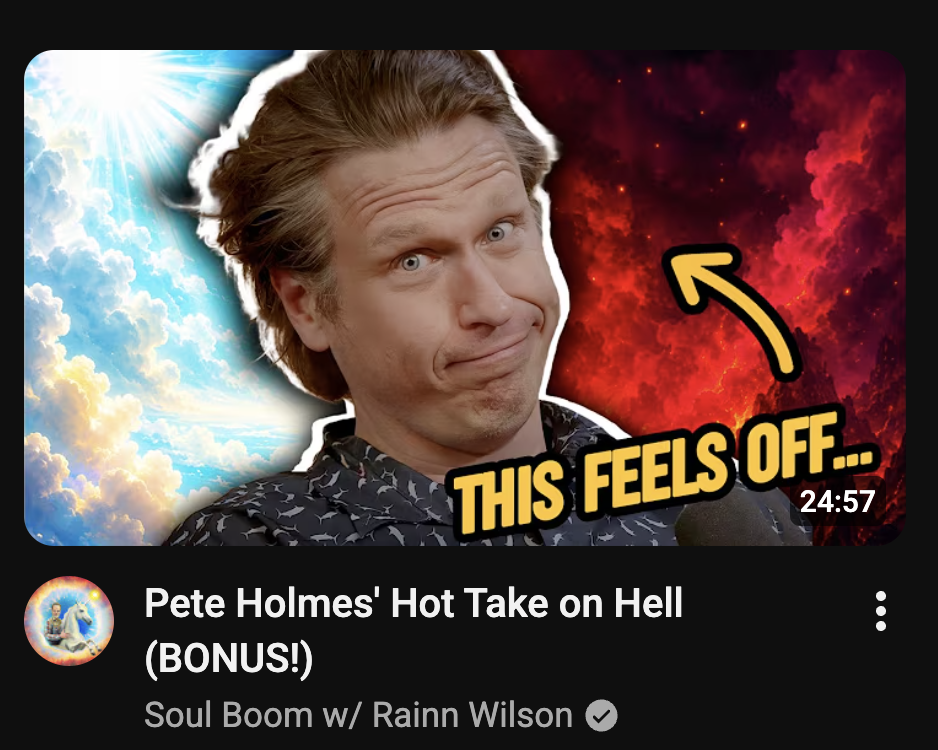
Rainn Wilson's podcast featuring Pete Holmes talking about Hell is the exact clickbait churches compete with today. People are skipping Sunday service to watch this on 2x speed instead.
We're all competing for attention. The church included. We live in an era where everything is a scroll away. Even social media has pivoted to this tactic. Social media used to be a place we went to connect with people, and now it's a place we go to be entertained. TikTok forced this change. So how is the church supposed to keep reaching people, keep engaging people, and keep our disciples being discipled? There's so much noise. How are we supposed to keep doing what the church is supposed to do?
It's important to remember that the church is still supposed to be the church. The Bible is still true. Every principle, every calling on you and your team and your church, all of it is still valid. Jesus hasn't returned yet. So we still gotta do what we gotta do.
Which brings us back to the question: how do we stay competitive in this attention economy?
Here's what I mean by “Attention Economy.” Netflix doesn't compete with other streaming services. Netflix competes with Fortnite, Roblox, and Minecraft. There are only so many hours in a day, in a week, in a month, and the people winning right now are the ones getting our attention. We are all entertained to the point of being sleep-deprived. So how do we keep doing what we're called to do as followers of Jesus in our communities with so many things drawing people’s attention?
Here's one tactic I think is genuinely worth leveraging: produce more content. The reason you produce more content is simple. You're trying to create more opportunities to grab people's attention. One service a week, a couple posts on social media, maybe an email once a week may not be enough anymore. It's hard to stand out when there's so much else flooding people's feeds. So the simplest way to compete in this attention economy is to increase your output.
Now, there's a fair counterargument to my point. Maybe we need less low-quality content and more high-quality content. Maybe producing less is actually better. But that assumes you're producing high-caliber stuff, that you're the Apple TV or HBO of content. Most likely you're not in that category. It's more likely you're producing content that's okay. It may not be world-class, but it's good. And it's valid, because there are eternal principles attached to it. God can use a donkey, and he can use you and me. So taking more swings in a week just gives you more chances for people to see what you're doing, maybe even show up to a service, get saved, and get plugged into the life of your church.
One of the most common ways people are competing in the Attention Economy right now is podcasting.
I was talking with a friend who was coaching a leader on a podcast strategy, and we landed on something I found insightful. There are things you just can't do in a weekend worship service, especially if you're outreach-minded. A weekly or bi-monthly podcast creates a whole new avenue to unpack important topics with your congregation and even community, and in addition gives you more content to upload to compete in the scroll. Also, creating a podcast is usually pretty easy. People tend to love less polished podcasts. They want an expert to casually chat about a topic and not lecture. It's a conversation with friends pods that takes over the charts on Apple Podcasts and Spotify. This is a perfect format for a pastor, I think.
Some of the most well-known leaders with some of the fastest-growing churches in the United States have podcasts. Now, I don't know if it's a chicken-and-egg thing. Are they famous so they podcast, or did the podcast help make them famous? I don't know. But what I do know is that it's true. It gives them more opportunities to talk to their church and engage with their community in a way that's easier to digest. People, especially in the United States, don't really want to sit around for two or three hours on a Sunday morning, at least in the American church, specifically in evangelical settings. But they'll happily listen to a podcast at two times speed while they work out or drive to work. And that increases your opportunity to disciple your people by capitalizing on this newer format. I’ve seen so many churches’ midweek programs shift to podcast strategies over the last fifteen years, repurposing that midweek in-person time for community engagement or small group programming.
So my encouragement here is not to create more content that's worse. My encouragement is to think about more ways to compete in this attention economy God has dropped us in. I'm not sure which idea is best for your organization or your church, but a podcast might be a simple way to start popping up in people's algorithms in the near future while better advancing your church’s vision and mission.