Beyond Talking Points: Why the Church Needs a Different Script
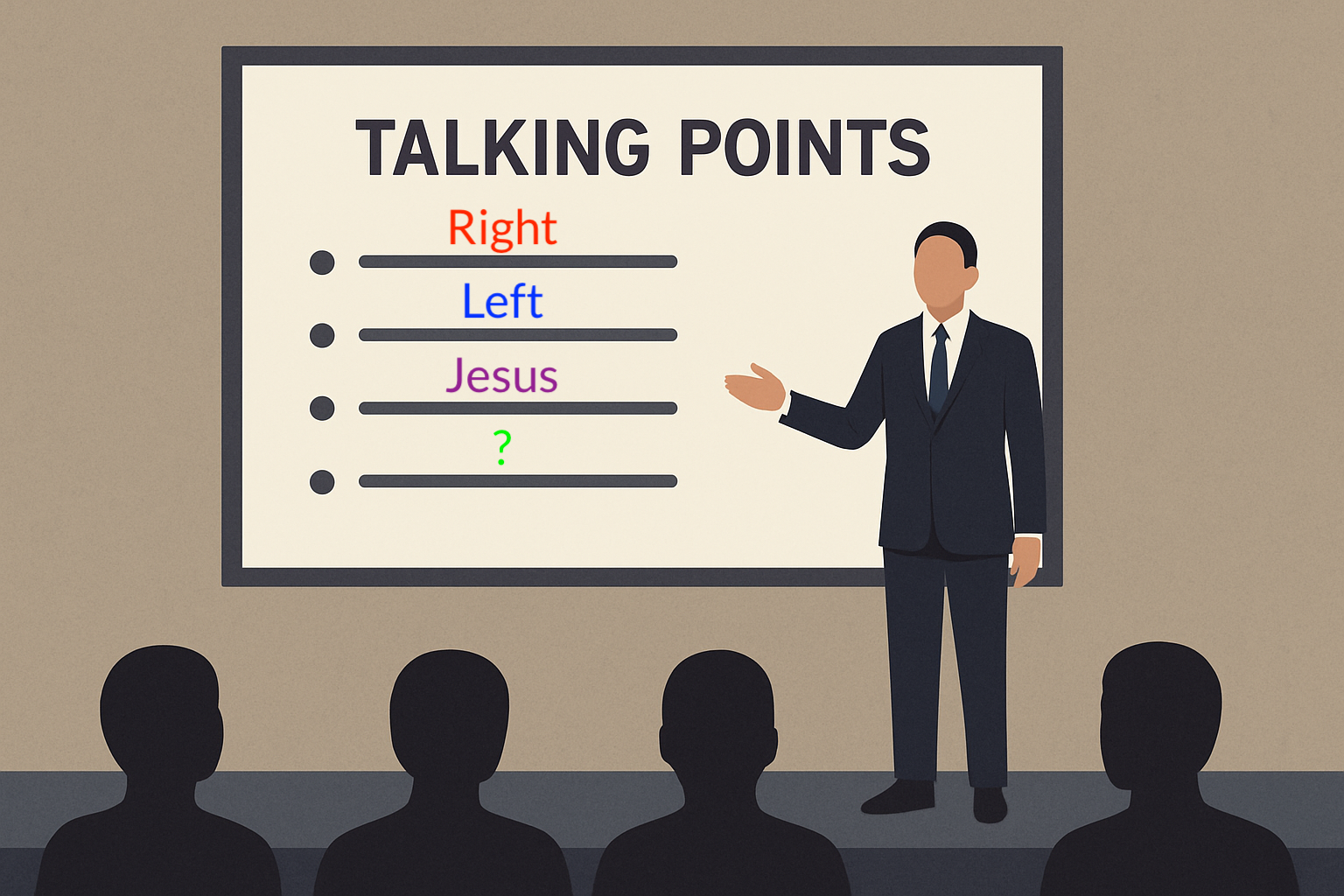
These political talking points have lost relevance to the 340 million people in the United States, a trend that has been true for a few years now. They definitely aren’t aligned with my goals as a follower of Jesus. The left/right narratives are generalizations of large groups of people. The latest tragedy always supercharges the rhetoric for one side, and the other side rolls their eyes, saying they are just generalizing for political points. Wait a few months, and the other side will jump in once it's their turn again. It's a sad game, and if we tap into the world's plot lines, we get muddied with their earthly agenda. Evil is evil. Call it what it is when it happens.
But, if you use these talking points, understand that the people who don't really follow this stuff will roll their eyes at you and your church. I don't think we should use the political headlines to reach people, but the eternal principles of the Bible. I know that some political talking points overlap with Biblical truths, but when you start at the political level, you are in a hole and have to do a lot of climbing to get out. Using political names and news headlines is extremely difficult because of the cultural baggage they bring. This is why aligning with a person politically in today's culture is dicey. You have to defend the person to the bitter end.
The revealing thing about tragedies is that you can easily tell where they get their news. They've been sipping at a political hose for years, and once they get a righteousness moment to pounce, they do. They feel better that they've gotten it out. People know their truth now. Typically, their tribe of like-minded people retweet and amen the post. Again, those reposts are them venting along with the person. They aren't alone with their feelings anymore. The question I think about is whether anything is different after that post. They vented, but did the other side hear them? Is anything different? This is the thing we've learned with social media over the last twenty years. Many people will post about an issue, but rarely does it lead to real action in their lives beyond just the words they typed on their iPhone.
If a friend hurts me, I have few options:
I can never tell them they hurt me and move on.
I can just throw up on them with no planning to get it all out.
I can thoughtfully consider what I need to hear from them and say it to them at the right time.
If you've ever been married, you've done this the right way and the wrong way. You might feel better for a moment when you get those pent-up feelings out, but if you do it wrong, it will lead to a few days of silence. But you can't just ignore the issues going on. If you don't address the problem, it will resurface later in a more significant way. Many people move on in today's culture, only to explode on social media with an all-caps post a few months later.
What I'm making a case for is that I don't see enough thoughtful planning on how to engage the cultural moments of today, considering our larger objectives as the church. The problem with the last approach is that it takes time. You can't post something in the moment. You need to pray. You need to ask for counsel. But you just want to post something. I get it. I've been there. It feels so good to post in a moment when your thoughts are spinning, but such posts often miss the mark and lead us astray from kingdom goals. I’ve definitely done this many times over the last twenty years.
This is why the words, the ways, and the timing of when we we engage culture are essential. It feels like both parties are like an almost-divorced couple hurling insults. Yes, it feels good when you've been hurt to lash out at the other person, but does it prevent the divorce? As a child of divorce, I can tell you this isn't fun being in the middle. The people of the United States are the children in this illustration, and the political parties are the parents. You might be thinking they are already divorced, but I'm not there just yet. I believe the church can be a mediator in this separation.
I was trained in a more seeker-sensitive way of thinking when engaging unbelievers. This approach is mainly rooted in being born and raised in California. I always assumed those around me didn't share my beliefs. Some places in the United States say they are losing Christian culture. I never felt like I had that, and I don't think that limited my ministry opportunities at all. If anything, I get to reach more people. I heard from a friend who does ministry in the South that their issue is they have to spend a bunch of time teaching people they aren't Christians because they think they are by default. That made me laugh when I first heard it. When people come to my church in California, they know they aren't Christian.
We need to be bolder in today's moment. The seeker-sensitive approach has become overly diluted over the past few decades, and now we must be more explicit about our beliefs. However, we don't need to adopt a political stance, resort to insults, or use headlines to rally our tribes. For example, churches are taking steps today to align with political parties, which in turn rally a core group of people who are hooked on cable news. Even using the phrase "cable news" might cause you to roll your eyes while reading this post. All these political words are triggering, and if we use these triggers, we have to deal with the response.
The problem with this two-party strategy language is that it leaves behind lots of people who don't follow any of this political stuff. They are working a 9-to-5, raising their kids, serving at your church, hopefully having a hobby, and barely keeping up with the headlines of culture. You might feel good venting on your social platform of choice or in a sermon, but you lose a lot of people who just see your tweet or maybe just hear about something you said, and as a result, group you with a whole political party, regardless of whether that was your intent or not. Again, the cultural talking points lean towards generalizations and typecasting of people. As a result, the person you are trying to reach sees you in a deep political hole, and you are stuck in that hole with those politicians.
One quick tangent, this is your reminder that online conversations don't always reflect how people actually feel. It's a fishbowl on these platforms. For example, there are approximately 250-300 million people who engage in X daily worldwide. But, they say only 10% of X users actually post. That means 25-30 million people generate the content you see on X. I’m curious if that number includes all the bots, because I bet the number is even smaller. The point is, X doesn't represent the majority of your community.
All I'm asking is to look towards the eternal horizon and not the one right in front of you. Yes, stand for truth and preach TRUTH. Understand where your people actually are and don't get fooled by cable news talking points, podcaster thoughts, and social media trends. Just because your scroll has a bunch of crap doesn’t mean it represents your congregation or community
This stuff is more complex than ever, but we can be a light for people and lead them out of the darkness with eternal principles. I just don't think the White House is the answer. You can chalk this up to me being too much of a contrarian if you disagree. I’m usually too lost in my own thoughts. Writing helps me personally process, or you might say, vent.