You Don’t Have to Be Duo or Die
The hype machine around new technology never stops. There is always another tool that promises to solve everything. Another platform to try. Another subscription to sign up for. Another pitch that implies, “If you just had this, your ministry would grow 2x.”
But the opposite extreme is just as loud. You have the people who clown every new thing. “You do not need it.” “Why change what has worked for two thousand years?” “Technology is ruining us.” “Go back to the old ways.” Somewhere between blind hype and total rejection is wisdom.
It feels a lot like sports talk today. You cannot simply say a team had a bad game. You always have a narrative to sell because stronger takes get more eyeballs. Fair and balanced is valuable, but it does not always get clicks. A team is not just struggling. Suddenly, they're the worst team ever. That kind of extreme reaction is what earns attention, and the same thing happens whenever new technology enters the conversation.
Duo or die
Last week, when Apple announced the iPhone Duo, the takes on X were overflowing. It was either the best idea ever or the worst idea ever. There was not much room in between. I was cracking up when I saw a reply from my friend Jon Rush: “Duo or die.”
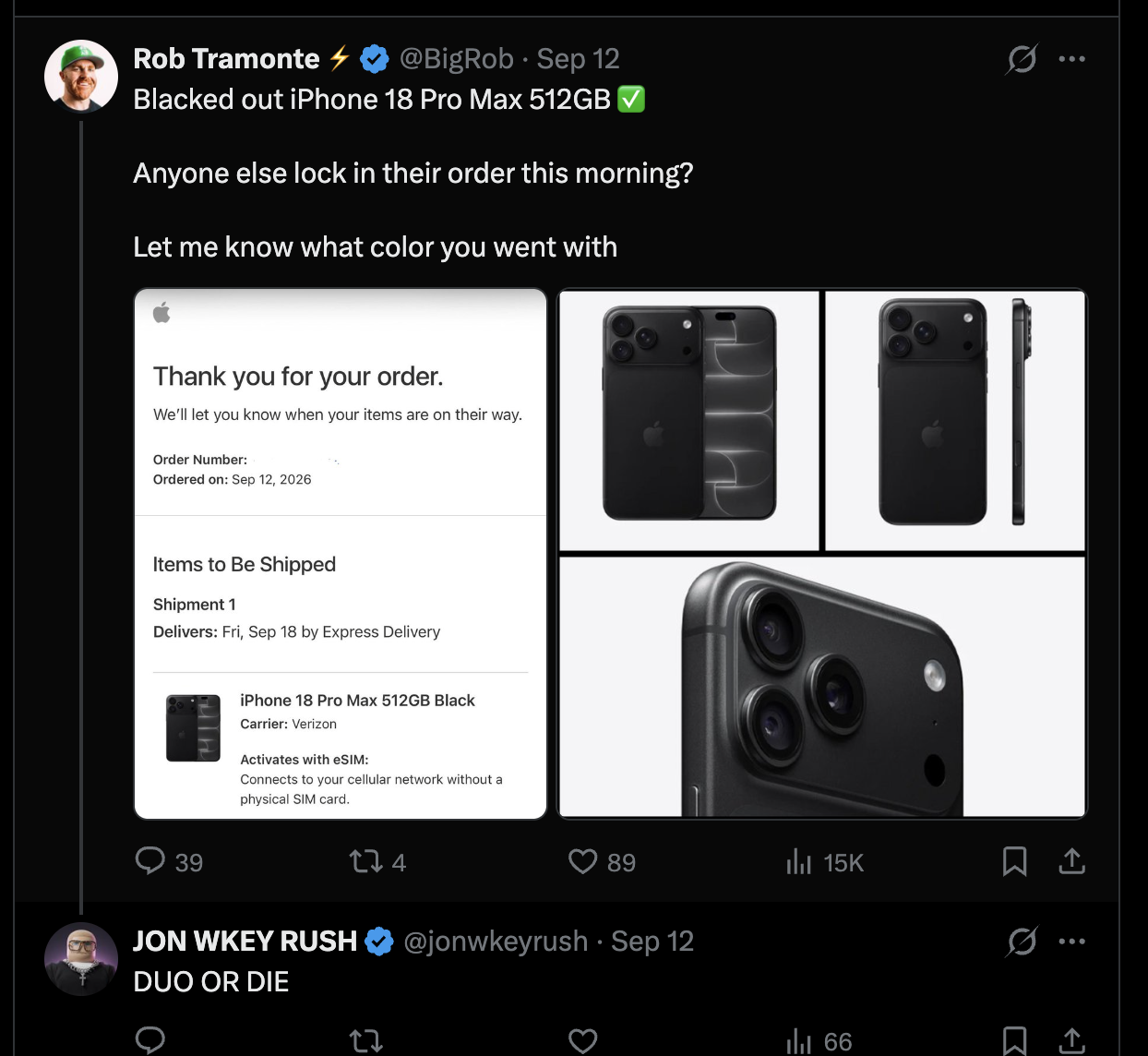
That pretty much captures how people engage with new things in today’s culture. Jon is a great follow, by the way. He is killing it in the faith and gaming space.

This is me admiring his jacket at a recent conference that I could NEVER pull off. I’m too much of a boring suburban dad.
The reality is you cannot have a tame opinion anymore. A few days later, I tweeted in response to an eye-catching, fear-driven title for a new book from The Gospel Coalition: “The AI Apocalypse: A Survival Guide for Humanity.” The title and cover are perfectly built for this moment, designed to rally people who already agree with the premise. But we should be careful not to let strong takes replace thoughtful evaluation.

Ask a better question
The point is not to embrace new technology simply because it is new. The point is to determine whether it helps your ministry's objectives. If the iPhone Duo can replace your iPad mini and make your work easier, get it. I love my iPhone. I love my MacBook Pro. I barely use my iPad. That means I probably do not need a Duo. But I also do not need to slam the Duo. I can see why it would be helpful for many people. It is just not helpful for me right now. That is a much healthier way to think about technology.
You do not have to love every new tool. You do not have to dismiss every new tool either. You simply need to ask whether it helps you do what you are trying to do.
A simple framework
The next time someone pitches you a new technology or subscription, ask two questions:
Does this move the needle for what we are trying to do in our community?
Is the price worth the result it will produce?
I regularly respond to pitches by saying, “I love the idea, but the price is not worth it yet.” Sometimes the technology is impressive, but the price point is off. I may like the product, but I know that spending that amount of money will not create enough movement to justify the investment. And I say that while working at a megachurch. You should absolutely feel permission to say the same thing at your church. Do not fall for the pitch just because the product is exciting, popular, or packaged with big promises. Evaluate it. Test it. Count the cost. Consider your actual objectives.
New technology is not automatically the answer, and it is not automatically the problem. It is a tool. Use it when it helps.
My pitch
If you want to explore this idea further, read Should Digital Transform or Enhance Your Church?.